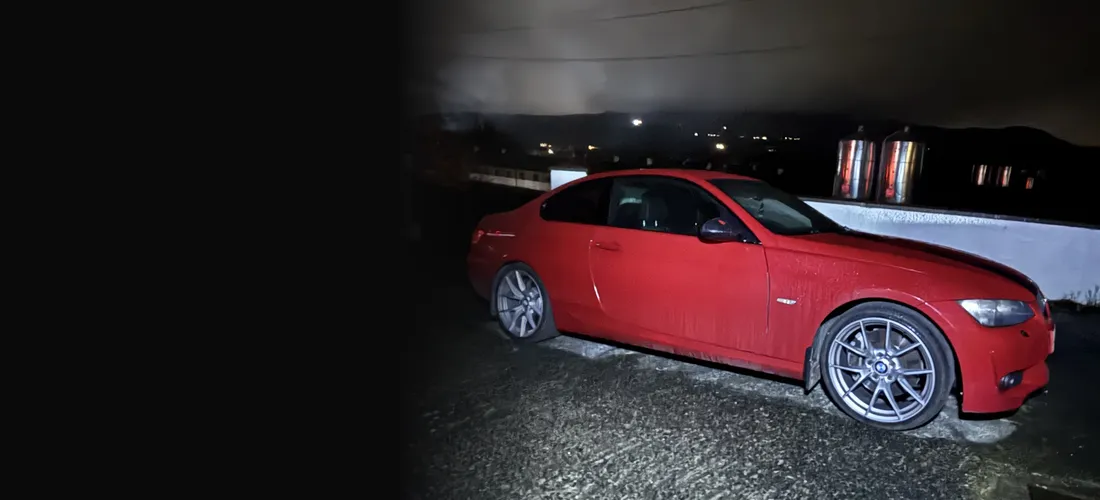
This BMW 330d coupé had been tuned twice before it came to us. It was already remapped when the owner bought it, and when he changed the exhaust he was told it needed mapping again, but it drove funny after. So ours was the third tune on this ECU.
Before we changed anything, we read the ECU and logged the car on the map it arrived with. What we found was a remap done the quick way: one number pasted over whole maps, extra fuel hidden where the engine's own protection can't see it, and BMW's protections switched off. And even like that, it wasn't strong.
What we found on the old map
Here's that remap's boost map, set against BMW's own: +225 mbar in every single cell, from idle to full throttle. That's not calibration. That's one number typed over a whole map.
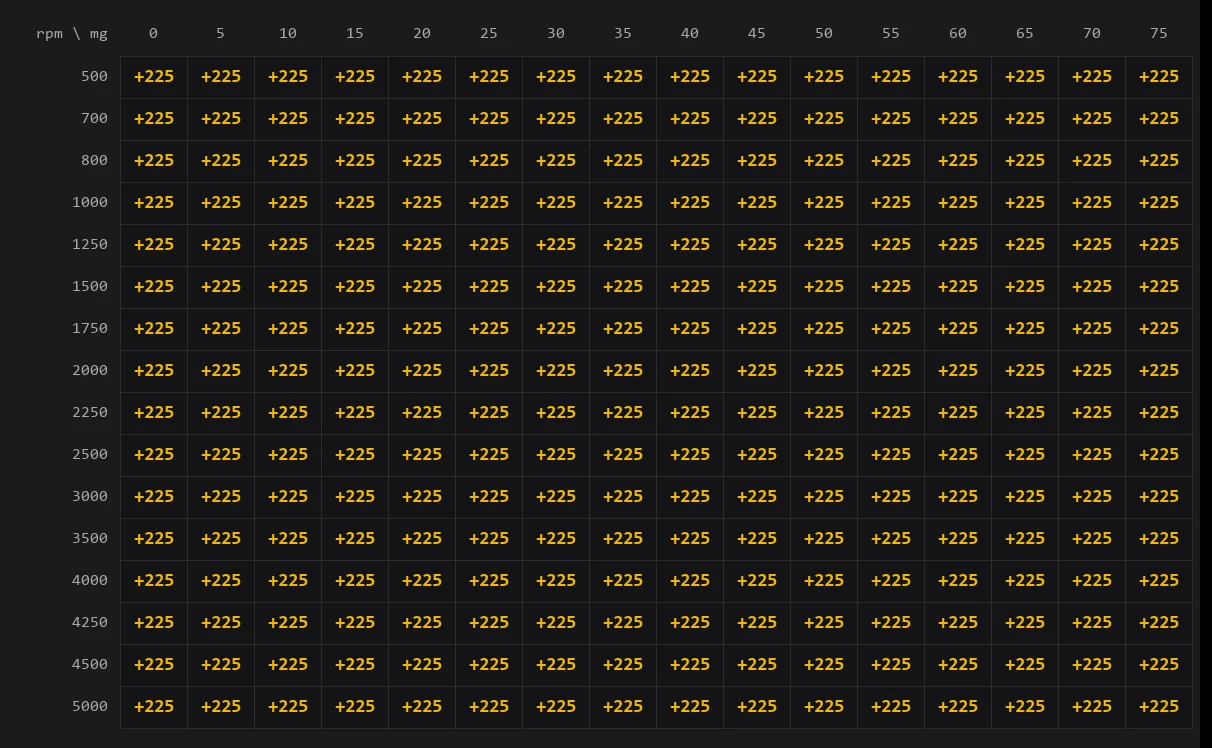
- The same boost added everywhere. +225 mbar at every engine speed and every load, even at 5 mg of fuel, where the engine is barely doing anything. And at full throttle it never reached the engine: a separate boost limit, left untouched, held the target at 2.5 bar. So the extra boost only turned up where you didn't need it.
- Fuel hidden in the injection time. About 7 % more injection time from 50 mg up, so the engine got more fuel than the ECU thought it was giving. The ECU's own smoke and torque protection then works from the wrong number. On top of that, another 7 % more fuel per Nm in the torque-to-fuel maps.
- No logic behind it. Both fuel changes were just 7 % added: to the last columns of the injection quantity maps, and to the injection time. Nothing shaped to engine speed or load. Adding injection time makes each injection last longer, so that hidden fuel goes in at the end, later in the combustion cycle, where it makes heat instead of power: hotter pistons, exhaust and turbo. Over time, that costs reliability.
- Protections switched off or flattened. The engine-overheat and altitude fuel protections were set to do nothing, the exhaust-temperature torque limit was one flat number, the torque limits were one flat number, and the limp-mode torque limit was raised from 600 to 720 Nm, so even in limp mode the engine wasn't being protected.
- And it still wasn't strong. The old map never lifted the ceiling on the engine's air-flow reading. It hit 732 kg/h at 3,250 rpm and stayed flat all the way to the gear change, so the smoke limiter held the fuel back: down from 74 mg at 2,100 rpm to 49 mg by 4,500. Past the mid-range, the top end just went flat.
What we put right
We took the old map off. The new calibration starts again from BMW's original and is built up from there, map by map. The car already had a tuned ZF gearbox and an uprated intercooler.
- Bigger fuel tables, not bent ones. Instead of forcing more fuel into BMW's tables, the injection-time and torque-to-fuel tables were made bigger, with more fuel and rail-pressure points following BMW's own slope. Nothing is hidden: the fuel the ECU works out is the fuel that goes in, with a small margin on the safe side, so its own smoke and torque protection work on true numbers.
- Boost where it's needed. Part-throttle boost is back to BMW's. Full-throttle boost rises with the fuel, and the boost limit was raised to match, so the extra air actually gets to the engine.
- Rail pressure and timing to match. 1,700 bar fuel pressure by 3,000 rpm, and injection one to two degrees earlier at the top end, where the extra fuel is.
- A clean smoke limit. The smoke limiter holds a clean mixture through the whole rev range.
What the logs showed
The clearest difference is the air. Below 2,250 rpm the old map is a touch ahead, which is its blanket boost showing at the bottom end. From 2,500 rpm up, the new calibration keeps breathing more, all the way to the gear change, while the old map's air reading sits flat from 3,250 rpm:
- Old remap
- New calibration
Show the numbers
| rpm | Old remap (kg/h) | New (kg/h) |
|---|---|---|
| 1,500 | 257 | 215 |
| 1,750 | 381 | 290 |
| 2,000 | 490 | 434 |
| 2,250 | 551 | 559 |
| 2,500 | 562 | 642 |
| 2,750 | 619 | 722 |
| 3,000 | 693 | 789 |
| 3,250 | 730 | 819 |
| 3,500 | 732 | 867 |
| 3,750 | 732 | 913 |
| 4,000 | 732 | 960 |
| 4,250 | 732 | 979 |
| 4,500 | 732 | – |
And the torque, between the two tunes. Low down, the old remap shows more, where its blanket boost and extra fuel come in early. From 2,500 rpm up, the new calibration is ahead all the way to the gear change: about 120 Nm more at 4,000 rpm, where the old map had run out of air.
- Old remap
- New calibration
Show the numbers
| rpm | Old remap (Nm) | New (Nm) |
|---|---|---|
| 1,500 | 450 | 348 |
| 1,750 | 563 | 442 |
| 2,000 | 622 | 551 |
| 2,250 | 627 | 622 |
| 2,500 | 583 | 639 |
| 2,750 | 567 | 647 |
| 3,000 | 559 | 640 |
| 3,250 | 532 | 615 |
| 3,500 | 492 | 595 |
| 3,750 | 463 | 583 |
| 4,000 | 442 | 564 |
| 4,250 | 414 | 528 |
| 4,500 | 389 | – |
- ✅ About 320 bhp and 650 Nm, against about 250 bhp and 635 Nm on the old remap
- ✅ Air flow up to 980 kg/h at 4,250 rpm, against a flat 732 kg/h on the old map: about a third more air at the top
- ✅ Boost 2.95 bar (absolute) at 2,800 rpm, right with its target, and still 2.7 bar at 4,000 rpm, where the old map was down to 2.4
- ✅ About a third more fuel at 4,000 rpm (around 80 mg against 59), at a clean mixture: no richer than lambda 1.07
- ✅ No smoke at all, and it pulls hard right to the gear change instead of going flat at 3,250 rpm
All of this with these protections back exactly as BMW set them:
- 🔒 Engine-overheat fuel protection
- 🔒 Altitude fuel protection
- 🔒 Limp-mode torque limit
The owner couldn't believe how well it went. With the uprated intercooler on it, we told him there was probably a bit more power to come if he wanted it. He said he was happy with the power it was producing.
M57 specialists
The BMW M57 3.0 straight-six diesel is one of the engines we specialise in. We've been through BMW's calibration for its Bosch ECU map by map: boost, fuel, injection timing, rail pressure, the smoke limiter and every protection, checked against BMW's own data. We know what each map does before we change it.
We've also seen what goes wrong. This isn't the first M57 we've had in on a remap like this one: an X5 3.0d came to us with the same blanket changes across its maps. A remap like that can feel quick on a test drive, but the engine doesn't get what it needs at the top, and its protections aren't looking after it.
Every M57 we do is read and logged before we touch it, and logged again after. We honestly don't think you'll find a better calibration for these engines anywhere.