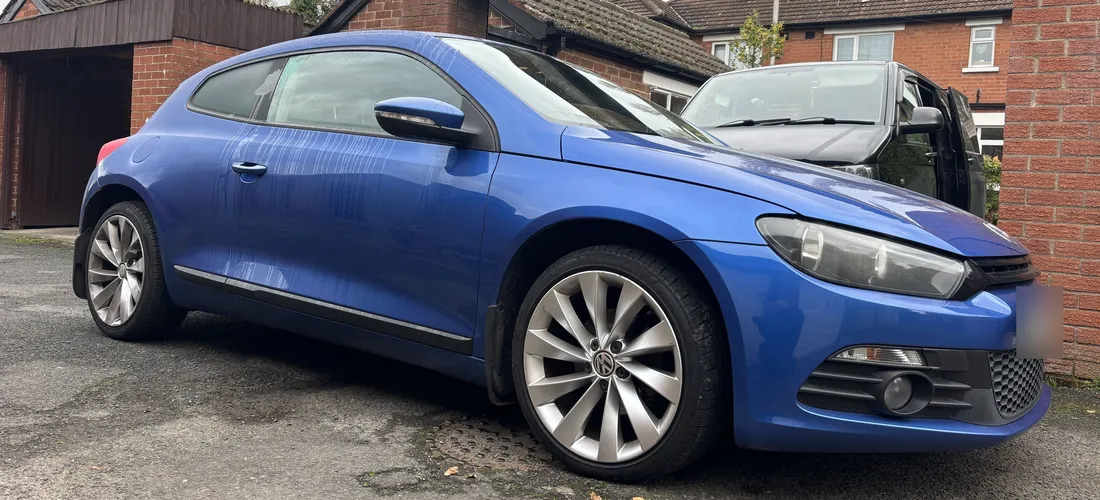
Our work · Volkswagen Scirocco 2.0 TDI 140 · Stage 1
Scirocco 2.0 TDI 140: from base file to fine-tuned
We loaded a base file into this 2011 Scirocco 2.0 TDI 140 and it made big numbers straight away: about 180 bhp and around 80 Nm more torque. But the logs showed it was running at about lambda 1.0, richer than we like to run a car with a DPF. So we started fine-tuning it, file by file, from the car's own logs.
The finished car pulls cleanly and smoothly from low down, with one rounded torque peak in the mid-range and an even roll-off to the top. No smoke, no flat spots, and cooler exhaust temperatures than the base file.
Getting the right software on the car
The car, on 90,000 miles, had its ECU on an older Volkswagen software version, which we updated to the newest version available before the 9977 update (if you know, you know). That leaves us a good base to start tuning from, as it's one we've tuned many times.
What the first logs showed
We logged the standard car first, then the base file, on the same road in the same gear:
- The standard car was healthy. Boost right on target, no faults, lambda 1.15 to 1.23 at full throttle.
- This engine breathes about 10 % less air than the car whose logs the base file was sized on, at the same boost. Same fuel, less air, so it runs richer, and that's exactly what the base file showed.
- Big power, but at lambda 0.97 to 1.00. The base file made about 180 bhp and 396 Nm at the crank, up from about 138 bhp and 318 Nm standard. But through the whole mid-range it was right on lambda 1.0. That's smoke, soot and heat.
- Exhaust temperature was climbing fast: 768 °C by 3,875 rpm and still rising when the pull ended.
- The extra fuel was burning late. With so much more fuel going in, injection was finishing 2 to 2.7 degrees later than on the standard car in the mid-range. A late burn makes heat instead of power.
- The torque curve was setting the fuel from 2,250 rpm up, so that's where the fix had to go, not the boost or the smoke limiter.
What we corrected on the second file
- Torque redrawn to this car's own air. We rebuilt the torque curve from the base file's log so the engine holds lambda around 1.05 through the rev range, instead of 1.0.
- One perfectly smooth curve. The new torque curve rises into one rounded peak and rolls off evenly, with no flats, no steps and no humps, and the same shape whatever the air pressure.
- Low end blended in. Between 1,750 and 2,000 rpm the old curve sat above the new one. In 3rd the turbo was still building boost there, but in a higher gear it would have made a rich hump, so we brought it into the same smooth line.
The third file
- A little more boost. Boost was being held at about 2.5 bar by the factory limit for sea-level conditions, not by the turbo. We raised it about 0.1 bar from 2,250 to 3,000 rpm, with the limits for higher altitude left as they were.
- Injection about one degree earlier at full load in the mid-range, so the burn finishes as early as it did on the standard car.
- Fuel pressure limits kept as they were. We looked at giving the fuel pressure more headroom and decided against it: the gap between those limits is a protection in itself.
We logged the third file and it showed it all working: boost 2.6 bar at 2,750 rpm right on target, lambda 1.04 to 1.13, injection finishing as early as standard or earlier, and the exhaust at 699 °C at 3,875 rpm against the base file's 768 °C. It also showed clean air to spare through the mid-range.
The final file
The fourth file puts that spare air to use: the torque curve goes up through the mid-range, still at lambda 1.05, still one smooth curve. Against the standard car and the base file:
- Stock
- Base file (lambda 1.0)
- Final file
Show the numbers
| rpm | Stock (Nm) | Base (Nm) | Final (Nm) |
|---|---|---|---|
| 1,625 | 288 | 272 | 291 |
| 1,875 | 338 | 326 | 341 |
| 2,125 | 352 | 417 | 387 |
| 2,375 | 356 | 437 | 399 |
| 2,625 | 357 | 440 | 406 |
| 2,875 | 354 | 433 | 409 |
| 3,125 | 347 | 424 | 404 |
| 3,375 | 332 | 413 | 395 |
| 3,625 | 321 | 398 | 382 |
| 3,875 | – | 386 | 367 |
| 4,125 | – | – | 348 |
| 4,375 | – | – | 329 |
| 4,625 | – | – | 314 |
- ✅ Around 170 bhp and 368 Nm at the crank, up from about 138 bhp and 318 Nm standard: +32 bhp and +50 Nm
- ✅ About 409 Nm as the ECU reports it, peaking around 2,750 to 2,875 rpm, in one smooth curve with no steps
- ✅ Lambda 1.05 through the rev range, against 0.97 to 1.00 on the base file
- ✅ Exhaust temperature cooler than the base file at every rpm
- ✅ More torque than standard everywhere from 1,500 rpm up
You'll see the base file sits higher on the chart, and it made about 10 bhp more at the top. That extra came from running at lambda 1.0, with the smoke and heat that go with it. We'd rather give you a car that makes its power cleanly and keeps doing it for years.
All of this was done with these protections left exactly as Volkswagen set them:
- 🔒 Oil temperature protection
- 🔒 Limp-mode and protection torque limits
- 🔒 Exhaust temperature sensor calibration
Why we love this engine
Here at BOSS ECU Calibrations we love these engines. We think the 2.0 TDI common rail is the best engine the VAG group ever made: quieter and smoother than the old PD engines, more economical, and dare we say it, more reliable, with no randomly throwing a leg out of bed!
Back when we started tuning, over 10 years ago, we tuned a 2.0 TDI common rail taxi that worked day and night. It covered over 630,000 miles faultless, and was just let down in the end by its fuel pump breaking down.
Build, log, refine, until the ECU and the engine agree. A base file is only the starting point: every car is logged when we tune it, and the logs decide the final file.